
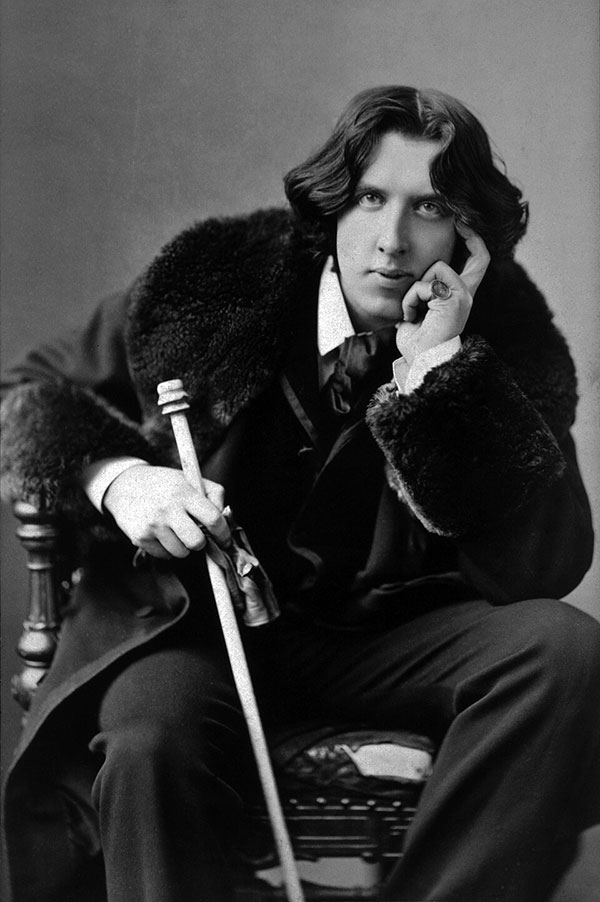
Oscar Fingal O’Flahertie Wills Wilde was born on October 16, 1854, in Dublin, Ireland. He was born into a cultured, intellectual household. His father, Sir William Wilde, was a prominent ear and eye surgeon as well as an antiquarian and writer. His mother, Jane Wilde (who wrote under the pen name Speranza), was a poet and an ardent supporter of Irish nationalism. Their home was filled with literary and political conversation, creating an environment that nurtured Wilde’s artistic talents from a young age.
Education and Early Life
Wilde excelled academically. He attended Trinity College, Dublin, where he won several prestigious prizes for his work in classics. He later earned a scholarship to Magdalen College, Oxford, where he deepened his interest in Aestheticism—the movement promoting “art for art’s sake.” At Oxford he won the Newdigate Prize for his poem “Ravenna”.
After graduating, he settled in London and quickly became known for his wit, flamboyant dress, and conversational brilliance. He lectured extensively in the UK and the United States, promoting aesthetic ideals.
Family Life
In 1884, Wilde married Constance Lloyd, a well-educated woman from a wealthy London family. They had two sons:
- Cyril (born 1885)
- Vyvyan (born 1886)
Their marriage, however, grew troubled as Wilde increasingly pursued relationships with men. His most notable relationship was with Lord Alfred Douglas, a young poet. Their involvement eventually led to Wilde’s downfall.
Imprisonment
In 1895, after a highly publicized legal battle with Douglas’s father, the Marquess of Queensberry, Wilde was convicted of “gross indecency” for homosexual acts. He was sentenced to two years of hard labor, which deeply damaged his health and career. During his imprisonment, he wrote one of his most powerful works, “De Profundis,” a long letter reflecting on his suffering and his relationship with Douglas.
After his release in 1897, Wilde lived in exile in France under the name Sebastian Melmoth.
Literary Works
Although Wilde is best known for his wit and plays, he wrote across many genres—novels, short stories, fairy tales, poems, and essays.
Major Works by Oscar Wilde
Novel
- The Picture of Dorian Gray (1890; revised 1891) — his only novel
Short Story Collections & Tales
- The Happy Prince and Other Tales (1888)
- Lord Arthur Savile’s Crime and Other Stories (1891)
- A House of Pomegranates (1891)
Plays (his greatest literary success)
- Lady Windermere’s Fan (1892)
- A Woman of No Importance (1893)
- An Ideal Husband (1895)
- The Importance of Being Earnest (1895) — his masterpiece
- Salomé (1893; originally in French)
Poetry and Prose
- Poems (1881)
- The Soul of Man Under Socialism (1891)
- De Profundis (written 1897; published posthumously 1905)
- The Ballad of Reading Gaol (1898)
Death and Legacy
Oscar Wilde died on November 30, 1900, in Paris, at the age of 46, from meningitis—likely a complication of injuries sustained in prison. He was buried in Père Lachaise Cemetery, where his tomb remains a site of literary pilgrimage.
Today, Wilde is celebrated for his dazzling wit, his sharp critique of Victorian society, his mastery of comedy, and his deep explorations of beauty, morality, and suffering. His works continue to be read, performed, and admired around the world.