
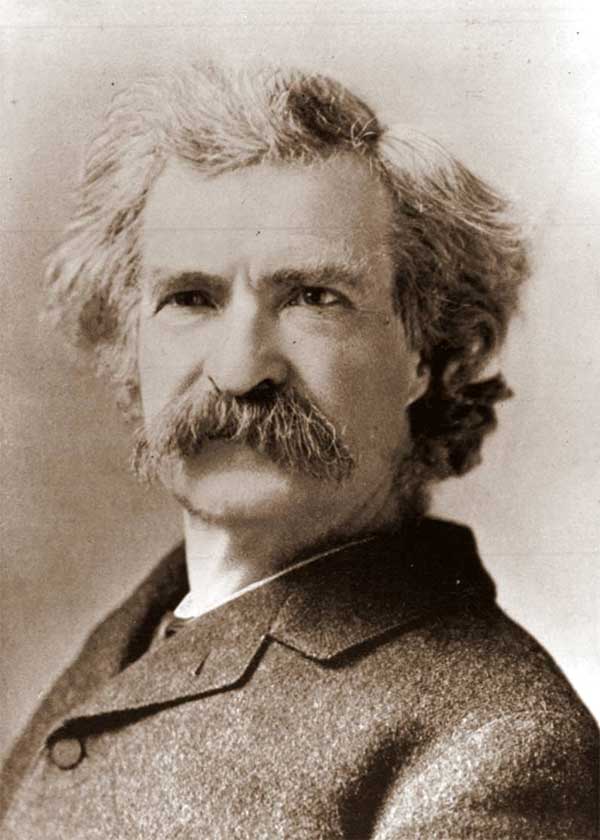
Mark Twain (born Samuel Langhorne Clemens, 30 November 1835 in Florida, Missouri, USA; died 21 April 1910 in Redding, Connecticut, USA) was an American author, humorist, lecturer, and social critic. He is widely regarded as one of the greatest writers in American literature and a master of wit and satire.
Early Life
Samuel Clemens was born into a moderately prosperous family in Missouri. His father, John Marshall Clemens, died when Samuel was 11, leaving the family in financial difficulties. Twain left school at age 12 to work as a printer’s apprentice and later became a riverboat pilot on the Mississippi River.
His experiences along the Mississippi deeply influenced his writing, providing material for many of his stories and novels. He adopted the pen name “Mark Twain” from a riverboat term indicating a safe depth of two fathoms.
Personal Life
In 1870, Twain married Olivia Langdon, a well-educated woman from Elmira, New York. They had four children: Langdon, Susy, Clara, and Jean. Tragically, Twain lost three of his children during his lifetime.
Twain traveled widely and became a popular lecturer, known for his humor and social commentary. He faced financial difficulties due to poor investments but eventually recovered through writing and lecturing. Twain’s personal life, marked by both joy and tragedy, deeply influenced his literary themes of human nature, society, and morality.
Major Works
Mark Twain wrote novels, short stories, essays, travel literature, and autobiographical works. His writing often blends humor, social critique, and realism.
Novels
- The Adventures of Tom Sawyer (1876) – Story of a mischievous boy growing up along the Mississippi River.
- Adventures of Huckleberry Finn (1884) – Considered his masterpiece; addresses race, freedom, and moral growth.
- The Prince and the Pauper (1881) – Historical novel about mistaken identity in England.
- A Connecticut Yankee in King Arthur’s Court (1889) – Satirical fantasy blending time travel and social commentary.
- The Tragedy of Pudd’nhead Wilson (1894) – Novel exploring identity and race in the American South.
Short Stories and Sketches
- Twain published many humorous sketches and short stories in newspapers and magazines, such as The Celebrated Jumping Frog of Calaveras County (1865), which brought him national attention.
Nonfiction and Travel Writing
- The Innocents Abroad (1869) – Satirical travel book about Twain’s journey through Europe and the Holy Land.
- Roughing It (1872) – Semi-autobiographical account of Twain’s early adventures in the American West.
- Life on the Mississippi (1883) – Memoir of his time as a riverboat pilot.
Autobiography
- Twain dictated his autobiography in stages; it was published posthumously as Mark Twain’s Autobiography (1924).
Legacy
Mark Twain is remembered as a towering figure in American literature. His works combine humor, social criticism, and vivid portrayals of life along the Mississippi and in 19th-century America. He influenced generations of writers and remains a symbol of American wit and literary excellence.
Twain’s keen observations on society, human nature, and injustice continue to resonate, making him a timeless voice in world literature.