
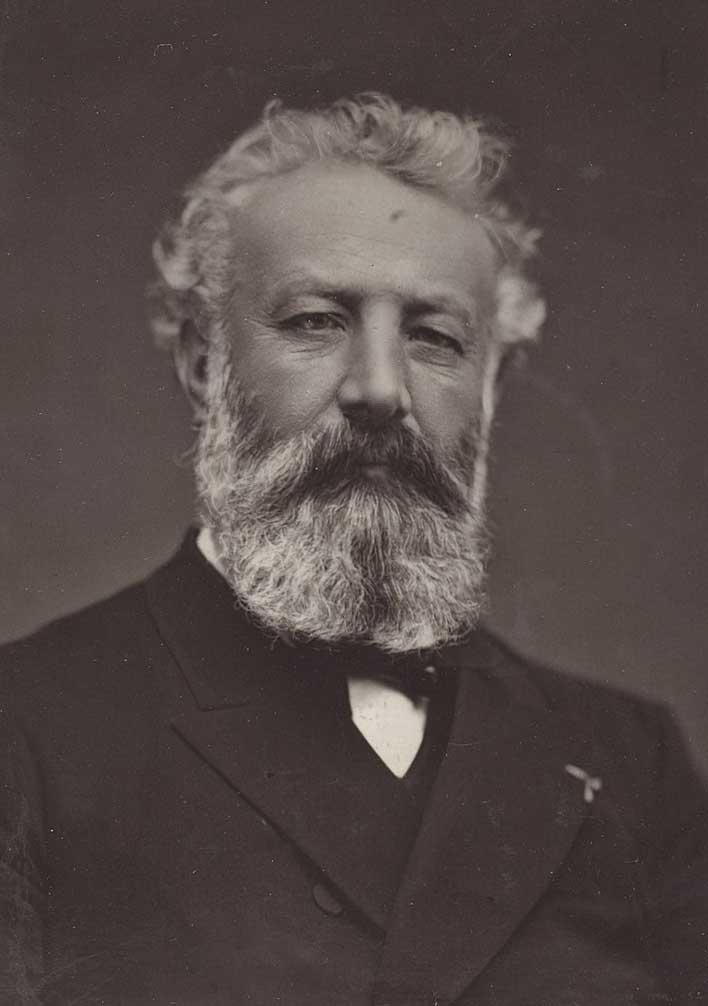
Jules Gabriel Verne (born 8 February 1828 in Nantes, France; died 24 March 1905 in Amiens, France) was a French novelist, playwright, and pioneering writer of science fiction. Often called the “Father of Science Fiction” (alongside H.G. Wells), Verne became one of the most translated authors in history.
Early Life
Verne grew up in a prosperous family in the port city of Nantes. His father was a lawyer who expected Jules to follow in his footsteps, while his mother came from a family of shipowners and sailors—a background that strongly influenced Verne’s fascination with travel, exploration, and adventure.
As a boy, Verne loved the sea and boats and often listened to sailors’ stories. According to family legend, he once tried to run away to sea at age 11, though this story is likely romanticized. He did, however, develop a lifelong passion for geography, navigation, and scientific discovery.
Verne moved to Paris in 1848 to study law, as his father wished. While there, he became involved in the city’s literary scene and began writing plays, operettas, and short stories. Eventually, he abandoned law for literature.
Personal Life
In 1857, Jules Verne married Honorine de Viane Morel, a widow with two daughters. Their marriage provided him with stability, though not always happiness—Verne was often restless and frustrated with domestic life.
Verne and Honorine had one son, Michel Verne, born in 1861. Michel was rebellious in youth, causing tension between father and son; later, Michel would help edit and publish some of Verne’s posthumous works.
Despite his fame, Verne led a relatively quiet, middle-class life in Amiens, where he eventually served on the city council for over fifteen years. In 1886, he was wounded in the leg by his emotionally troubled nephew, leaving him with a limp for the rest of his life.
He died in 1905 of complications from diabetes.
Major Works
Jules Verne wrote more than 60 novels, many of them part of his famous series “Voyages Extraordinaires” (“Extraordinary Voyages”). His stories combined adventure, science, exploration, and imagination—often predicting technologies that did not yet exist.
Famous Novels
- Five Weeks in a Balloon (1863)
- Journey to the Center of the Earth (1864)
- From the Earth to the Moon (1865)
- Twenty Thousand Leagues Under the Seas (1870)
- Around the World in Eighty Days (1872)
- The Mysterious Island (1875)
- The Survivors of the Chancellor (1875)
- Michael Strogoff (1876)
- Off on a Comet (1877)
- The Steam House (1880)
- Robur the Conqueror (1886)
- Master of the World (1904)
Themes and Innovation
Verne’s works often explored:
- Submarines (Nautilus in 20,000 Leagues Under the Seas)
- Space travel (From the Earth to the Moon)
- Air travel and flying machines (Robur the Conqueror)
- Deep-sea exploration
- Lost worlds and scientific mysteries
His combination of adventure storytelling with technological speculation laid the foundation for modern science fiction.
Legacy
Jules Verne’s imaginative works have inspired scientists, explorers, and writers for more than 150 years. Many of his ideas—electric submarines, space travel, and global circumnavigation—anticipated real technologies. His books continue to be adapted into films, television shows, comics, and stage works.
Verne remains one of the most translated authors of all time, and his influence on science fiction and popular literature is immeasurable.